
The Rope

Everyone is talking about “integration.”
Integration of the Syrian Democratic Forces into the Syrian army. Integration of the autonomous administration into the Syrian state. Integration of the institutions of North and East Syria into the new order in Damascus.
But let’s be precise about what is actually happening.
This is not integration. It is severance. And what is being severed is not territory, not oil, not institutions.
It is the bond between a leadership and its people.
That bond is the only thing that actually matters. It is the center of gravity of the entire project. And Damascus understands this far better than many of the people defending it.
What the January Offensive Revealed
When the offensive began, the military picture was bad very quickly.
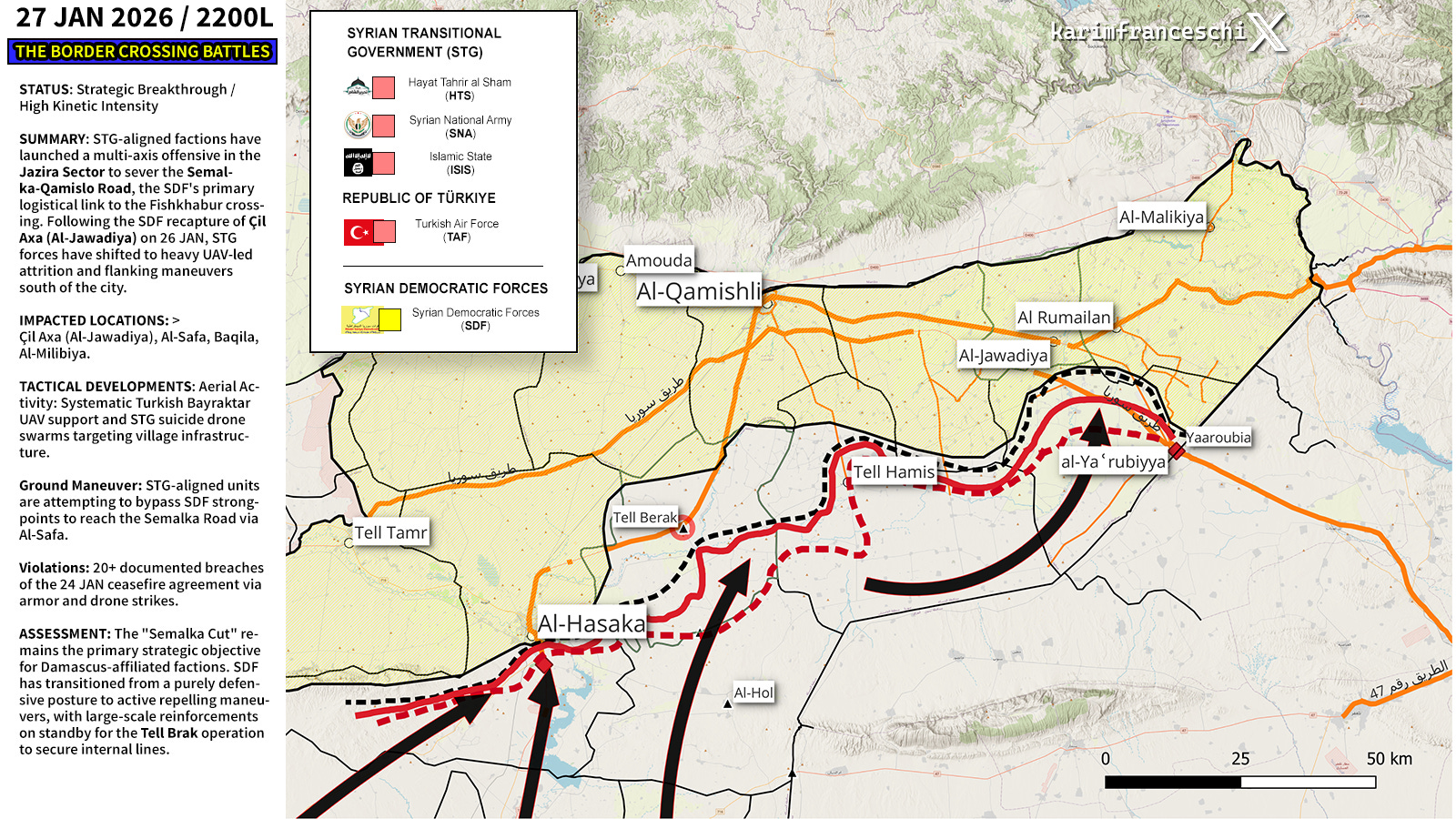
Territories the SDF had held for years collapsed in days. Places liberated from ISIS during the long campaign across northern Syria — Raqqa, Tabqa, Deir ez-Zor, Shaddadi — were retaken almost overnight. By the time it was over, the SDF controlled less territory than it held in 2014, before the United States stepped up support during the siege of Kobani and the battle of Sinjar. Every gain of the ISIS campaign, every kilometer paid for in blood, was gone.
The mass desertion of the Arab component of the SDF was a warning that had been visible for years. Democratic confederalism was the declared ideology. But North and East Syria never fully became what it claimed to be. There were no meaningful elections. The local councils had real power over daily administration but no stake in strategic decisions. The Arab tribes, the Syriac communities, the vast alliance that nominally sustained the project — they were partners of utility, not participants in a shared political vision. When the United States signaled a shift, those alliances dissolved in days, as they had survived for centuries: by switching to the winner.
But the collapse stopped.
It stopped when the offensive reached the Kurdish heartlands. Kobani. Hasakah. The Jazira. And something happened that Damascus, Ankara, and the international actors quietly backing the operation had not fully calculated.
Kurdish society mobilized.
Politicians who had spent years behind desks came into the streets with weapons. The civilian administration armed itself. People were preparing to fight street by street, district by district. Kurds across all four parts of occupied Kurdistan mobilized politically. The diaspora mobilized. Kurdish allies mobilized in European capitals and in Washington.
For the first time in years, there was a genuine possibility that this war would stop being a Syrian military operation and become something transnational, something that Damascus could not contain. A Kurdish mobilization crossing state borders — through Iran, Iraq, Turkey, Syria simultaneously — is not a problem that can be solved with an armored offensive. It is a regional crisis.
That possibility scared everyone. Ahmed al-Sharaa had to recalculate. The international actors backing him had to recalculate. Even those who had quietly greenlighted the retaking of Arab-majority territories had not signed off on igniting a regional conflagration.
And so the January 29 agreement was signed.
It was presented as a political achievement. It was a conditional surrender. And the momentum that had, for a brief moment, created real leverage — on the battlefield, in Western capitals, in the halls of Congress — was killed.
The Surgical Campaign
Since January 29, what Damascus has been doing is not complicated. It is surgical.
The goal is not to send columns of armor into Kobani again. The goal is to complete the work without firing a shot — by separating the Kurdish leadership from the mobilization capacity that stopped the offensive in the first place.
Watch the signals being sent.
The head of internal security in Aleppo — the man who presided over the siege of Sheikh Maqsoud and Ashrafiyah, who was the public face of the operation that killed Ziad Halab, the commander who led the Kurdish resistance in those neighborhoods, who became the symbol of that resistance — walked into the Asayish headquarters in Kobani. He sat across from the Asayish commander there and told him: you will operate under my command. You are integrating under me.
This is the same promise that was made to Ziad Halab in Sheikh Maqsoud. The fighters there were promised they could keep their internal security structure, that the Asayish would remain, that they would run their own neighborhood. They demilitarized. The SDF pulled back heavy weapons. And then the siege tightened and everyone died.
That man is now inside the headquarters of the Asayish in Kobani.
Sipan Hamo, one of the most recognized SDF commanders from the early YPG era, has been photographed smiling, shaking hands, embracing figures with Kurdish blood on their hands. The gesture is strategic — it signals to Damascus and to the international powers pressing for integration that the leadership is serious, that it is willing to proceed, that another kinetic operation is not necessary.
But every signal sent upward is received downward.
And the signal reaching the average fighter, the average Heval, is something else entirely.
The State of Denial
On the ground, the psychological response is denial.
The average fighter does not believe any of this is real. They see the Syrian Interior Ministry flags raised in Qamishli and Hasakah and tell themselves it is theater — a long-game tactical performance, buying time while the core structure remains intact underneath. They do not believe for a second that they will be asked to genuinely surrender their symbols, their structure, their project to a government in Damascus led by a man they regard as a Salafi jihadist in a suit, no different from the fighters they faced in Raqqa and al-Bab and Manbij.
They may be right that it is a long game. The KCK movement has navigated ceasefires and negotiations and apparent retreats for decades and found language that, to the uninitiated, looks like surrender and, to those who understand the movement’s history, reveals that not a single inch was conceded in principle.
But there is a problem with that framework now that did not exist before.
The January offensive happened. The SDF collapsed across most of its territory. The losses were real and visible and humiliating. The leadership is not navigating from a position of strength while buying time. They are negotiating under the credible threat of annihilation, with the full backing of the Western international order behind their adversary.
And the population can feel the difference.
The Fractures Appearing
We are already seeing things that would have been unthinkable six months ago.
A prisoner exchange was announced. Hundreds of SDF members had been held. When the first batch was released, the breakdown became public: the released prisoners were overwhelmingly Arab. Kurdish fighters remained in detention. The reaction was immediate and fierce — not just anger at Damascus, but anger directed at the autonomous administration itself, at the leadership for accepting these terms, for not fighting harder, for not being transparent about what had been agreed and what had been surrendered.
More than a thousand SDF prisoners are reportedly still held by Damascus. That number, and what the leadership knew about it and when, is becoming a flashpoint.
Each of these incidents — the prisoner numbers, the photographs of handshakes, the flags in Qamishli, the officials marching through Hasakah — pulls on the same rope. The rope between the administration and the people who once made that administration real. The people who fought for it, who buried children for it, who spent a decade in displacement for it.
The leadership appears to believe that rope is strong enough to sustain the strain. I am not certain they are right. I have watched it for years. I know what it is made of. And I can see how fast it is fraying.
The Leverage That Was Built and Then Abandoned
The January mobilization did something important that has not been fully acknowledged.
It created political leverage inside Western democracies that the Kurdish movement had not held in years.
Western governments may be willing to work with Ahmed al-Sharaa. Western societies are not. There is no European electorate that enthusiastically supports empowering a former senior figure in al-Qaeda’s Syrian network, a man who has acknowledged that the September 11 attacks inspired him to pursue jihad, a man who operated within the organizational structures of Abu Bakr al-Baghdadi. The political leaders who moved quickly to embrace the new Syrian leadership — von der Leyen, others — did so without popular mandate and faced genuine domestic pressure as a result.
The Kurdish mobilization gave actors inside those systems something to work with. Legislators pushed the Stop the War on the Kurds Act through processes that normally move at a fraction of that speed. European parliamentarians openly challenged the rush toward normalization. For a brief moment, the concentrated support of Western governments for al-Sharaa was being meaningfully contested by mobilized civil society.
That leverage existed because Kurdish society and Kurdish leadership were visibly, credibly unified. When one side fights while the other negotiates, that unity fractures. And fractured unity is legible to everyone watching.
The moment the administration signals integration, the leverage evaporates. The moment Kurdish society signals loss of faith in the administration, the leverage evaporates from the other direction.
Damascus understands this. The integration process is designed, in part, to produce exactly this outcome — to isolate the leadership from its base and the base from its leadership, until the political weight that mobilization created dissolves on its own.
What Cannot Be Integrated
There is a reason this process is called integration and not absorption. The language matters. Integration implies mutual adjustment, a negotiated synthesis, something preserved on both sides.
But the two systems involved are not compatible at any structural level.
North and East Syria emerged from a specific political philosophy — democratic confederalism, gender liberation as a foundational military and civic principle, multi-ethnic governance built on explicit rejection of the nation-state model. In practice, that project was always more centralized and security-heavy than the theory suggested, constrained by a decade of warfare, Turkish intelligence operations, ISIS, sanctions, the permanent siege economy. The proto-communes, the women’s villages, the grassroots councils — these existed as prototypes, not as a functioning parallel society. The ideal was never fully realized.
But the ideal was real to the people who fought for it. And the gap between the ideal and the current reality — an administration signaling subordination to a centralized Damascus state led by a former jihadist commander — is not a gap that political language can bridge indefinitely.
The new Syrian state under al-Sharaa was built on exactly the opposite logic: consolidation of armed factions under a single command, assertion of central authority, elimination of parallel structures. Every warlord in his coalition holds a ministry. Every faction holds a piece of territory. The political settlement in Damascus is a carve-up, not a democratic experiment.
These structures cannot be merged. One absorbs the other, or one destroys the other. The history of revolutionary movements being integrated into centralized states does not offer encouraging precedents.
The Hedge and the Insurance Policy
There is one reason the offensive stopped where it did, and one reason Damascus has not simply finished the job.
The international actors backing al-Sharaa want centralized authority in Syria. They want stability. They want the oil deals — the Chevron agreement announced immediately after January 29 was not a coincidence; it was a signal of what the integration of northeastern Syria’s resources into the new order looks like in practice.
But they do not fully trust him.
Al-Sharaa is one of the few figures capable of holding together the pragmatist and Salafi-jihadist wings of the Syrian opposition coalition. That is a rare political skill. It is also an extremely unstable equilibrium. If he is assassinated — and the list of people who would benefit from his assassination is long — Syria could fragment very quickly into something that no outside power can manage.
So the SDF is being kept. Not as a free actor. As an insurance policy. A structured force in the northeast, enough to be reactivated if Damascus collapses or turns, enough to remind al-Sharaa that his international backing is conditional. The Kurds are permitted to exist — culturally, aesthetically, in the aesthetic language of autonomy — as long as they remain manageable and as long as they serve that function.
This is the darkest reading of the situation. But it is also the most structurally coherent one.
The Rope
I lost so of my closest friends during Raqqa’s liberation campaign. The idea of returning what was purchased at that price is not something I approach with equanimity.
But I also know the families who buried sons and daughters. I know the people who spent years in displacement camps, who watched children try to cross the Mediterranean, who in some cases watched them drown. For those people, this is not a question of ideology or historical legacy. It is a question of what can be extracted from this situation to make their lives survivable.
The leadership of North and East Syria is gambling that they can perform integration for the cameras while preserving the core of the project in the spaces between the lines. They may be right. They have done versions of this before.
But they are doing it now with a base that has just watched the military collapse of everything the movement built over a decade. They are doing it while suppressing internal dissent, while managing the optics of handshakes and salutes with figures who killed Kurdish commanders, while keeping the population insufficiently informed about what was actually agreed on January 29 and what has been agreed since.
Every one of those choices pulls on the same rope.
The rope that connects a political project to the people who give it life.
If that rope holds, the movement survives this phase and finds a new form. The YPJ moves into the Asayish and preserves its ideological core in a police uniform. The international experience ends in Syria and continues in Rojhelat, in the diaspora, in whatever comes next. The leadership plays its long game and the project endures beneath the surface of apparent integration.
But if the rope snaps — not from another offensive, but from the slow accumulation of humiliations, opaque negotiations, skewed prisoner releases, and photographs of smiles with murderers — then Damascus will have completed something remarkable.
The dismantling of a revolution.
Without firing a single shot.